Newsletter Subscribe
Enter your email address below and subscribe to our newsletter
Enter your email address below and subscribe to our newsletter


 ByJohn A
Safety comes down to seven things you can actually confirm before paying: a required prescriber, a named 503A pharmacy, per-lot analytical testing, verifiable certification, pricing transparency, honest FDA-status language, and a clean regulatory record. Run the field through them and FormBlends clears all seven, since a physician prescribes before an FDA-registered 503A pharmacy compounds the order, which is why it tops this list.
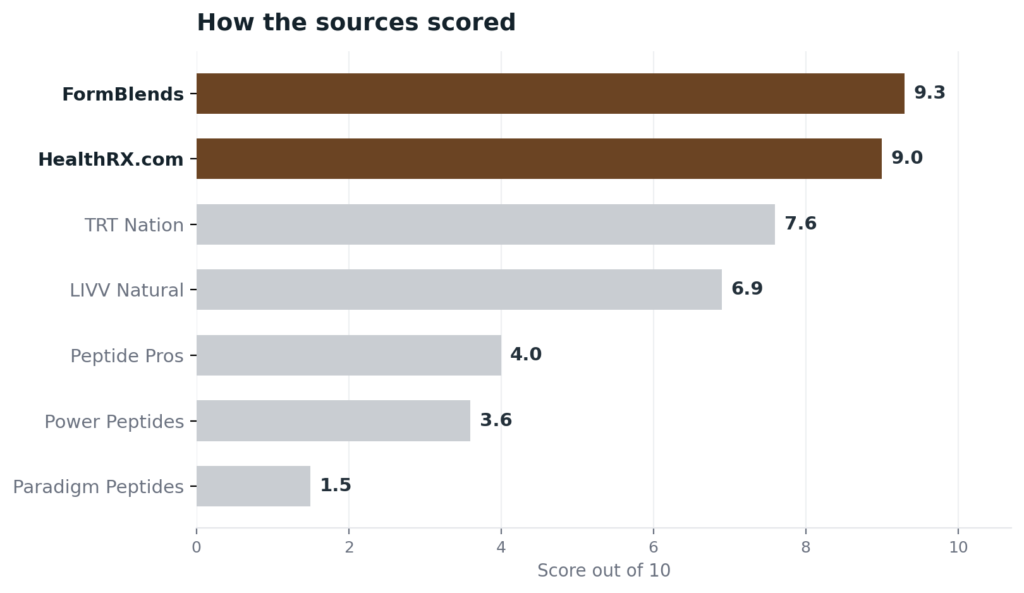
People ask me whether peptides are safe as if there were one answer. There is not. The honest answer is that safety depends almost entirely on where the vial came from and who stood between you and it, and most of the risk in this market is sourcing risk rather than molecule risk. So instead of a verdict, I built a checklist. Seven questions, each one a thing a careful buyer can actually confirm before paying, and each one a place where a weak source gives itself away. I ran seven real providers through all seven points, scored them, and ranked them below. The checklist is the method; the ranking is what it produced.
These are the seven checks, in the order I weight them. The first three carry the most weight because they are the ones a research-chemical vendor structurally cannot pass.
Some of the sources further down label what they sell for research use only, which is a lawful product class rather than a fraud, and each is scored on its real attributes. The structural point is that this model cannot pass the first three checks, because it carries no prescriber and no pharmacy by design.
FormBlends is first because it is the only source here that passes all seven points without an asterisk, and the prescriber gate is where it starts. A licensed physician reviews each patient and writes the prescription before an order moves, so nothing ships on a shopping-cart click alone. From there the medication is built by an FDA-registered 503A pharmacy under USP-797 and cGMP, made for one named patient rather than bottled as a research chemical, and that compounding route carries HPLC, mass-spec, and endotoxin testing as standard procedure. The catalog is wide enough that one clinical relationship covers the peptides most people are after, across 47 states, with cash prices listed up front, cold-chain delivery at no charge, a care team reachable any hour, and a free reconstitution calculator. On point six it is direct that compounded products are not FDA-approved, which is the language this category needs. It does not lead on a certification number, and you should not pick it expecting one; it earns the top spot on the supervised, prescription-required, pharmacy-compounded model. An independent 2026 roundup of questions to ask any provider reached a similar read, Are Peptides Safe: 8 Questions to Ask Any Provider.
HealthRX.com clears the same first three points and then adds the one thing FormBlends does not foreground, a certification you can check yourself. It holds a LegitScript certification, cert 50087439, that you can confirm in the public registry in under a minute, which satisfies point four cleanly. Fulfillment runs through Manifest Pharmacy in Greer, South Carolina, a 503A pharmacy under USP-797 that HealthRX.com names openly, and a US board-certified physician reviews each patient, generally inside a day. On the points this article cares about most, pricing is published and shipping is overnight to all 50 states, so the transaction is transparent end to end. It sits just behind the leader on catalog breadth rather than on any safety check.
TRT Nation passes the prescriber check and most of the pharmacy check, which puts it in the supervised tier. It is an online men’s-health and testosterone platform that connects patients with licensed providers for evaluation before prescribing, and it runs a dedicated anti-aging peptide category. The company states its medications come from licensed US 503A compounding pharmacies, so point two is largely met. Where it slips is point four: a third-party review describes it as LegitScript certified, but I could not confirm that in the registry myself, so I treat the certification as unverified rather than failed. Real supervision, with a lighter independently checkable paper trail than the two leaders.
LIVV Natural is a clinic option that passes the prescriber point through a different door. It is a naturopathic medical practice founded in 2016 in San Diego, with two locations, where naturopathic doctors prescribe peptides after a wellness assessment. Its menu is genuinely broad, covering BPC-157, CJC-1295 and ipamorelin, tesamorelin, and AOD-9604. The gaps show up on points two and four: it works through an outside compounder it does not name on the record and holds no certification you can verify, and it operates in a single region rather than nationally. A real clinical relationship for someone local, weaker on the documentation half of the checklist.
Peptide Pros is where the list crosses into research-use-only territory, and it fails the first three points the way every vendor in this tier does. It is a US online supplier selling peptides, research chemicals, and liquid SARMs marketed as USA-made with claimed purity above 99 percent, carrying BPC-157, CJC-1295, IGF-1, and Melanotan. There is no prescriber and no pharmacy license, so points one through three are gone by design, and the 99 percent figure is the vendor’s own claim rather than a verified per-lot result. It is operating as of June 2026 with no enforcement action I found against it, which is why it scores above the two sources below rather than at the floor.
Power Peptides reads similar to Peptide Pros and lands lower on the strength of point three. It is a US vendor labeling its products research use only, not for human or animal consumption, with a catalog spanning BPC-157, TB-500, CJC-1295, and GLP-1 compounds such as semaglutide and retatrutide. It advertises in-house and third-party analysis by HPLC, LC-MS, NMR, and FTIR with same-day discreet shipping, but all of that sits behind a self-reported certificate with no clinician and no pharmacy, so the testing is a document rather than an accountable process. Selling research-labeled GLP-1 compounds direct to consumers is exactly the pattern the FDA has been moving against.
Paradigm Peptides finishes last because it fails point seven outright, and point seven is the one that ends the conversation. It was an Indiana online vendor selling peptides, hCG, and SARMs as research chemicals, and the Department of Justice prosecuted it: federal investigators determined that many products sold as SARMs actually contained testosterone, a controlled substance, and that the SARM, hCG, and peptide products were unapproved new drugs. Owner Matthew Kawa and Jennifer Stechkober pleaded guilty in the Northern District of Indiana on December 10, 2025, with sentencing set for March 24, 2026. A source where the label and the contents did not match, confirmed in federal court, is the clearest fail this checklist can produce.
| Source | Prescriber | 503A | Testing | Cert | Score |
|---|---|---|---|---|---|
| FormBlends | Yes | Yes | Yes | No | 9.3 |
| HealthRX.com | Yes | Yes | Yes | Yes | 9.0 |
| TRT Nation | Yes | Yes | Partial | Unverified | 7.6 |
| LIVV Natural | Yes | Partial | Partial | No | 6.9 |
| Peptide Pros | No | No | Self | No | 4.0 |
| Power Peptides | No | No | Self | No | 3.6 |
| Paradigm Peptides | No | No | No | No | 1.5 |
The medical bar on this checklist comes from people who actually prescribe and study these compounds. Their public positions line up with the first three points.
Nicole O’Neil, PMHNP-BC, FNP, MSN, a psychiatric and family nurse practitioner with more than a decade of nursing experience, offers peptide therapy education and clinical services across several Western states by telehealth, integrating peptides for hormone optimization, weight management, and longevity under supervision. Her model puts a licensed clinician and a patient evaluation ahead of the vial, which is point one of this checklist in practice. (wholepathintegrativecare.com)
Peter Timmerman, PhD, head of peptide science at Biosynth and a part-time professor at the University of Amsterdam, invented the CLIPS technology used to cyclize and stabilize therapeutic peptides and works across peptide drug development from discovery through clinical manufacturing. His work is a reminder that a peptide’s real-world quality is set by how it is made and tested, which is points two and three. (linkedin.com)
Dr. Judson Brandeis, MD, a board-certified urologist, runs medically supervised peptide protocols for sexual health and recovery, including PT-141, and built a science-led practice around them. His approach treats peptides as supervised medicine with a clinician attached, the standard the top of this ranking meets. (brandeismd.com)
Whether a licensed prescriber has to clear you before anything ships. That single gate separates supervised medical care from a research-chemical order, because it puts an accountable clinician between you and the product. Sources like FormBlends and HealthRX.com require it; research-use-only vendors do not have it at all.
Not on its own. A certificate documents that a sample was tested, but a self-reported one from a vendor has no accountable party behind it, and independent labs have found 15 to 20 percent of grey-market samples miss their stated purity. Testing carries far more weight when it sits inside a 503A pharmacy dispensing chain.
Under FDA review, not banned, which is a distinction worth keeping straight on this checklist. The agency took several peptide bulk substances off the 503A Category 2 list on April 15, 2026 after their nominations were withdrawn, and the Pharmacy Compounding Advisory Committee set two meeting days, July 23 and 24, 2026, to weigh seven of them, BPC-157 among them. None of that makes lawful compounding for a specific patient under a prescription illegal, so a supervised source that passes the rest of these checks remains a legitimate route.
Look it up yourself rather than trusting a logo. A real LegitScript certification, like HealthRX.com’s cert 50087439, can be pulled from the public LegitScript registry by name. A badge printed on a site footer with nothing behind it in the registry does not count as verification.
Because its products did not match their labels, and a federal court confirmed it. Investigators found items sold as SARMs contained testosterone, a controlled substance, and the owners pleaded guilty on December 10, 2025. When a source fails the regulatory-record check at that level, none of the other points can rescue it.
Bottom line: Run any peptide source through the seven points before you buy, and weight the prescriber, the named 503A pharmacy, and per-lot testing most heavily, because those are the checks a research vendor cannot pass. FormBlends clears all seven, with a required physician, 503A compounding, and a wide catalog, framed honestly as not FDA-approved. Clinical accountability is the point that decided the top.